
Behold the Man

Scripture Reading: 2 Kings 9-10; John 19; Psalm 141
“So Jesus came out, wearing the crown of thorns and the purple robe. Pilate said to them, ‘Behold the man!’” (John 19:5)
When Pilate brought Jesus out before the crowd, humiliated and bloodied, he said, “Behold the man!” What he meant as a display of defeat and shame was, in God’s providence, a declaration of something far deeper. “Behold the man”—yes, behold the Second Adam, the one who would undo what the first Adam had broken.
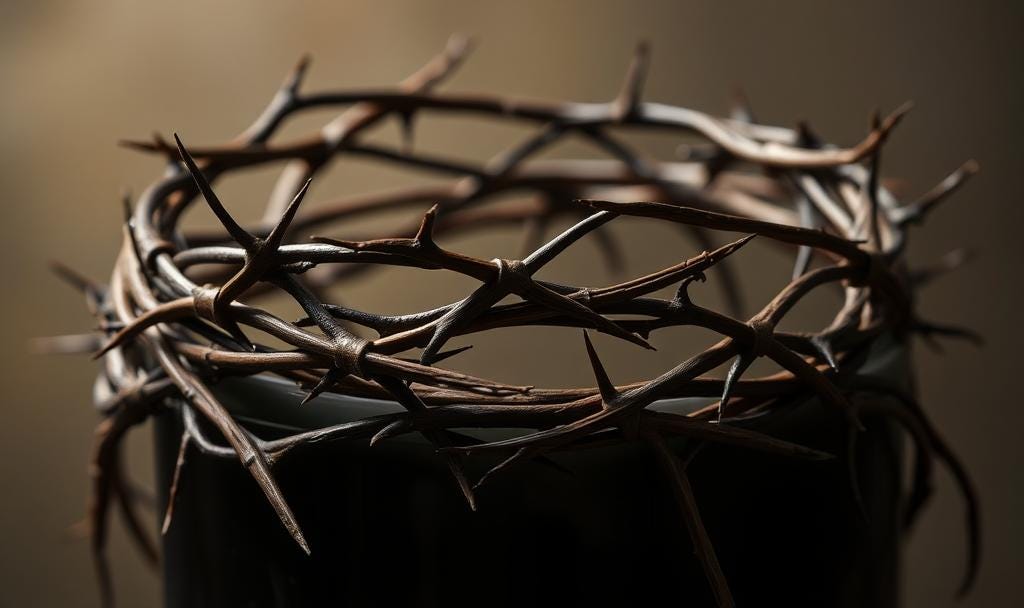
One detail stands out: the crown of thorns.
The soldiers placed it on Jesus’ head to mock Him, twisting together the thorns and forcing them into His brow. But Scripture invites us to see more than cruelty. This crown, made of thorns, reaches back to the first time thorns appeared in the Bible.
In Genesis 3:17–18, after Adam’s sin, God pronounced a curse on the ground:
“Cursed is the ground because of you… thorns and thistles it shall bring forth for you.”
Thorns were the first fruits of the fall—emblems of a world broken by sin. They represent toil, suffering, futility, and the judgment that falls on creation because of human rebellion.
So when Jesus wore a crown of thorns, it was more than mockery. It was a powerful symbol: He was bearing the curse (Galatians 3:13). He was crowned with our fallenness, our guilt, our sorrow. The King of glory wore the curse so we could wear righteousness and life.
What Adam lost, Christ came to restore. As Romans 5:19 says,
“For as by the one man’s disobedience the many were made sinners, so by the one man’s obedience the many will be made righteous.”
Pilate told the crowd to behold a beaten man. But the eyes of faith see more: the curse-bearer, the redeeming King, the Man of Sorrows crowned with thorns so that we might one day be crowned with life.
When you think of Jesus’ crown, don’t just see the pain—see the purpose.
He wore the curse so that, in Him, you could be free from it.
Behold the Man. And worship.
Steven, this was beautifully written—piercing, profound, and rooted in rich biblical theology. The moment you unpacked the crown of thorns as more than mockery… I felt the weight of that symbolism in a fresh way.
You didn’t just offer a devotional thought—you gave us a window into the redemptive plan of God stretching from Eden to Calvary. The way you tied Genesis 3 to John 19 was masterful: thorns as the fruit of the fall… now pressed into the brow of the Redeemer. That is gospel gold.
🟢 “He was crowned with our fallenness, our guilt, our sorrow.” 🟢
That line hit hard. It’s easy to glance past the crown of thorns like it's just another detail in the passion narrative. But your insight shows us—it wasn’t just bloodshed, it was prophetic fulfillment. He wore the curse that we inherited so we could wear the righteousness we didn’t deserve (2 Corinthians 5:21).
And the contrast between Pilate’s sarcastic "Behold the man" and the eyes of faith that see "Behold the Lamb of God"—that flips the whole narrative. What man meant for humiliation, heaven declared as coronation.
This is a message the church needs to hear again: Christ didn’t just die for sin—He wore its curse, crushed its shame, and reversed its power. Every thorn pressed into His head was a symbol of a lie we believed in Adam—and a truth He reclaimed in Himself.
Thank you for inviting us not just to read the passion—but to behold the Man.
I’m worshiping with fresh tears today.
—Matthew Adams
MyR2B Ministries – Hearing God’s Voice, Living by His Cross