Drink from Your Own Well
30 Days in Proverbs - Day 13

After warning his son about the destructive power of sexual sin, the father in Proverbs 5 does something important: he offers more than a warning. He gives a positive vision. Battles against sin are rarely won by fear alone. Desire must be met, not merely denied.
There is a common but mistaken idea that Christianity is opposed to sex, as though sin entered the world when Adam and Eve became sexual beings. Scripture teaches the opposite. God created them male and female and called their union good. Desire itself is not the problem. What we do with desire is where sin enters.
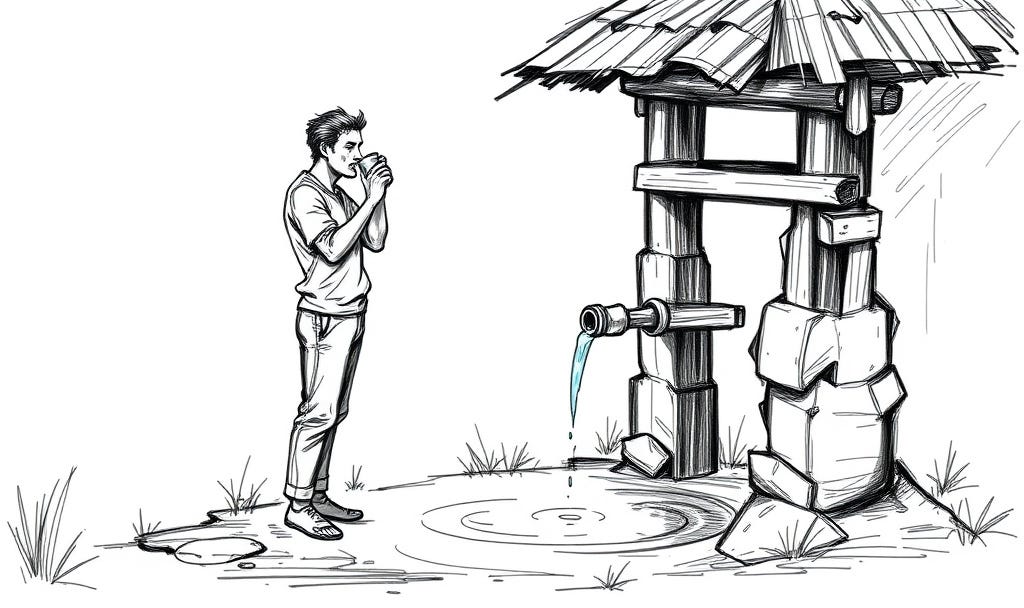
So Solomon points his son to God’s design. Using the imagery of wells and fountains, he compares sexual desire to thirst. Thirst is not immoral. It is natural. And God, in His wisdom, has provided a legitimate and good place for that thirst to be satisfied: the covenant of marriage.
The possessive language Solomon uses is meant to highlight exclusivity, not ownership. Marriage is not domination or control, but mutual belonging. Scripture insists that this belonging goes both ways. The husband belongs to his wife just as truly as the wife belongs to her husband. Marriage is sacred precisely because it is exclusive, reciprocal, and covenantal.
This is why Solomon urges intentionality. Many translations repeat the word “let,” emphasizing choice. A husband must actively direct his affection, attention, and imagination toward his wife rather than allowing desire to wander unchecked. The same, of course, is true for a wife toward her husband. Faithfulness does not happen accidentally.
In this way, marriage is not only a moral safeguard but a spiritual act. Throughout Scripture, adultery and idolatry are closely linked. Faithfulness to God is described in marital terms, and unfaithfulness as betrayal. Wisdom itself is personified as a woman who gives life, ultimately fulfilled in Christ, the wisdom of God. To live faithfully within marriage is to align oneself with Wisdom; to pursue lust is to place oneself under the influence of the devil.
This does not mean every act of sexual sin is conscious act of devil worship. But it does mean our choices shape our loyalties. Marriage is given to bless and preserve life. Temptation exploits desire in order to destroy it. These are not merely two behaviors, but two rival ways of life.
The passage ends soberly. Though temptation is powerful and spiritual forces are at work, we are not helpless. In the end, we choose. Sexual sin is like building a trap and then stepping into it, or weaving the rope that binds us.
Only a fool builds his own snare. Thankfully, Scripture also teaches that God delights to rescue fools who repent and return to Him.